Bracelet, Card, or Nothing? Weighing the Case for Medical Alert ID When You Have G6PD
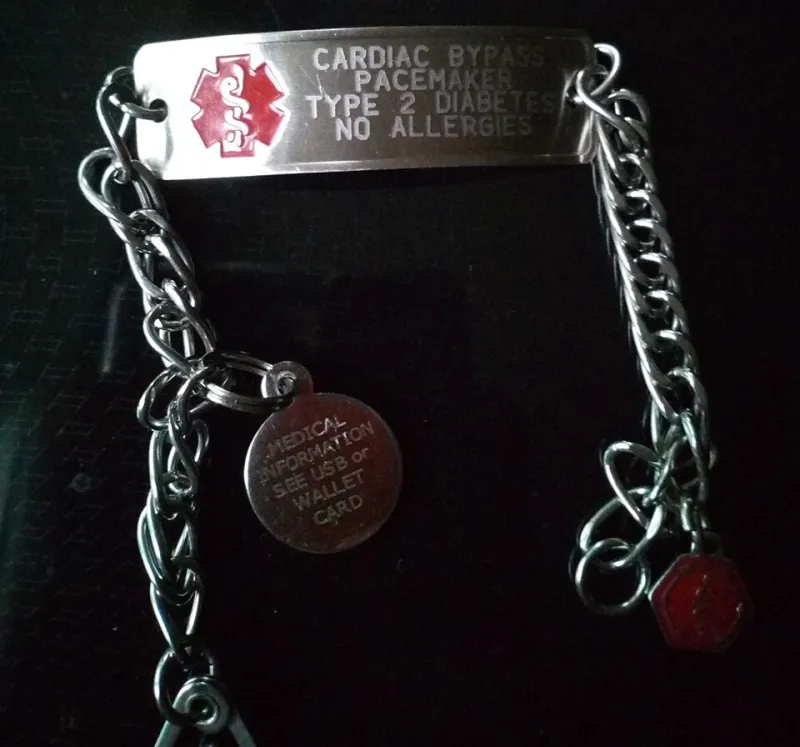
Photo: RexxS, CC BY-SA 4.0, via Wikimedia Commons
Ask ten G6PD patients whether they carry medical alert identification and you'll get roughly ten different answers — delivered with surprising passion for what is, on its face, a question about jewelry.
The debate matters because G6PD deficiency occupies an awkward middle ground among medical conditions. It's not an allergy that will send you into anaphylaxis on a stretcher, and it's not a condition paramedics will encounter daily. It is, however, a condition in which a single well-intentioned prescription can trigger a hemolytic crisis — which makes the question of whether emergency personnel can access your information a genuinely consequential one.
The Case For: When the Engraving Earns Its Keep
The strongest argument for medical alert ID comes from the moments when everything else fails.
Consider the patient, unconscious or disoriented, arriving at an unfamiliar emergency department. Consider the urgent care clinic that reaches for a standard prescription — a sulfonamide, a quinolone, an antimalarial — without a complete medication history. Consider the family member who can't reach you and can't remember the name of your hematologist.
In each scenario, a bracelet engraved with "G6PD DEFICIENCY — NO PRIMAQUINE / SULFA / NAPHALENE" does something no app, no memory, and no medical record system can guarantee: it speaks when the patient cannot, in the one place emergency responders are trained to look.
Several patients describe exactly these saves. One reported that a pharmacist, upon noticing the bracelet during a routine pickup, flagged a prescribed medication and called the prescriber before dispensing. Another credited a wallet card with prompting a faster workup when she presented with dark urine during travel.
The Case Against: What ID Can't Do
Skeptics raise fair points.
Engravings get ignored. More than one patient has reported that hospital staff never looked at the bracelet — or worse, saw it and didn't know what G6PD meant. An ID is only as effective as the reader's familiarity with the condition, and G6PD is not on most first responders' daily list.
False reassurance. A bracelet is not a substitute for a medication list, an emergency contact, or an informed primary care physician. Patients who treat it as a complete solution may underinvest in the systems that actually prevent crises.
The disclosure question. Some patients — particularly adolescents and young adults — resist visible ID because it invites questions they aren't ready to answer. For a condition that is usually asymptomatic, the daily social cost can feel heavier than the episodic medical benefit.
The Options, Compared
Engraved bracelets and necklaces. Products from established US providers such as MedicAlert Foundation, StickyJ, and Lauren's Hope offer permanent, battery-free identification. MedicAlert adds a 24-hour hotline and linked health profile for responders. Cost typically runs from roughly $20 for basic stainless steel to $100+ for premium designs; MedicAlert memberships add annual fees. The downside: visibility, and limited space for detail.
Wallet cards. A printed card listing your diagnosis, medication contraindications, physician, and emergency contacts costs almost nothing and carries far more detail than any engraving. The catch: it only works if you carry it, and responders must find it. Many patients keep one behind their driver's license and one in a spouse's wallet.
Phone-based profiles. Both iPhone (Medical ID, accessible from the lock screen) and Android (Emergency Information) allow responders to view critical details without a passcode. Free, detailed, and updated easily — but dependent on the phone being present, charged, and known to the responder.
A Decision Framework
There is no single right answer, but three factors should drive yours:
Lifestyle. Frequent travelers, students living away from home, and anyone whose daily routine takes them far from informed family members gains the most from layered ID. Patients whose entire care team is local and informed may reasonably carry less.
Severity and history. If you've had a significant hemolytic episode, or your triggers are hard to predict, the case for redundancy strengthens. A completely asymptomatic patient with a well-documented chart faces lower stakes from a gap in identification.
Risk tolerance. Ask yourself honestly: if you were rendered unable to speak in an unfamiliar city tonight, what is the probability the right information reaches the right person? If the honest answer is "I don't know," you've identified the gap worth closing.
The Reasonable Middle Path
For many patients, the strongest configuration isn't a bracelet alone but a layered approach: a lock-screen medical profile on the phone, a detailed wallet card, and — for those comfortable with visibility — a bracelet or pendant engraved with the essentials. The specific medications that concern G6PD patients vary, so work with your physician to decide what belongs on the engraving; listing the condition plus the highest-priority drug classes is more useful than a long list that gets truncated.
Medical alert ID is not magic, and it is not mandatory. But for a condition whose greatest danger is a stranger's good intention, giving the right information to the right person at the right moment is one of the cheapest forms of protection available.